TAITMAIL Art and technology? No fear!
Genius, Dr Johnson said in his dictionary, is “The protecting or ruling power of man, places or things”. So is AI genius? It’s scary, we’re being told so daily so it must be. It will kill us because, although we’ve invented it in our limited ingenuity, it is cleverer than we are and, naturally, will want to destroy us. I’m not convinced.
Seems to me that with or without AI, creative genius is a uniquely human quality – the good doctor doesn’t go into that - and nowhere is it better demonstrated than at the Royal College of Art.
For many the Royal College of Art is exactly that: an independent post-graduate institution for the development of painters, sculptors and allied occupations.
What they either set aside or don’t know is that the RCA began life in 1837 as the Metropolitan School of Design, and was later incorporated into Prince Albert’s educational estate at South Kensington (V&A, Natural History Museum, Albert Hall etc), funded out of the profits of the 1851 Great Exhibition. It was created, says Christopher Frayling, a former RCA principal and cultural historian in his 1987 history of the RCA, to train designers for industry so that we could compete with the industrial powerhouses of France and Bavaria. “Design students should never be allowed to experience the joys of practice on ‘the fine arts’” he said of the approach the Victorians believed the college should take. It wasn’t until 1896 that it got its present title with a sub-heading of School of Fine and Applied Arts, but for most of the rest of its life it was a misnomer.
And although many only know the RCA through its most famous painter and sculpture alumni – Tracey Emin, Peter Blake, Barbara Hepworth, David Hockney - it has equally lustrous design graduates in the likes of Thomas Heatherwick (design), Zandra Rhodes (textiles), David Adjaye (architecture), Mary Quant (fashion) and James Dyson (vacuum cleaners).
In fact, this year it’s the world’s leading design college for the 12th year in succession.
As it is, RCA graduates design most of the world’s interesting motor cars, and the former professor of drawing, Bryan Kneale, was proud that his classes were full of industrial designers, seldom if ever with any fine artists.
But its previous vice-chancellor, Paul Thompson, who was behind the development of the college’s’ new £155m Battersea campus which opened in 2021, insisted at that time that fine art was an essential part of the design process, always had been and very much still is - “We’re very very committed to the medieval technologies that still exist in jewellery, metal, ceramics and glass” he said then, adding that at least half of the Battersea campus would be occupied by fine art students.
The truth is that the RCA is constantly pouring successful design into the public domain for which the disciplines of the drawing board and the palette are intrinsic: the Ford Ka; the Jaguar XK8; IKEA’s PS furniture range; Eglu, the easy-to-clean chicken coop; the concrete canvas, a rapid shelter solution for disaster and military situations; Automist, an intelligent fire-suppression sprinkler.
Still confused? Me too, a bit, till I had news this week from the RCA about five new research projects for which it’s got funding, and mostly deploy partnerships, which echo what Thompson had to say. They include studies on interactive spaces for music performances, digital doodads for turning historic textiles into modern fabrics, collaborative cultural networks, and then it gets serious with interactive technology for teaching engineering.
Here they are.
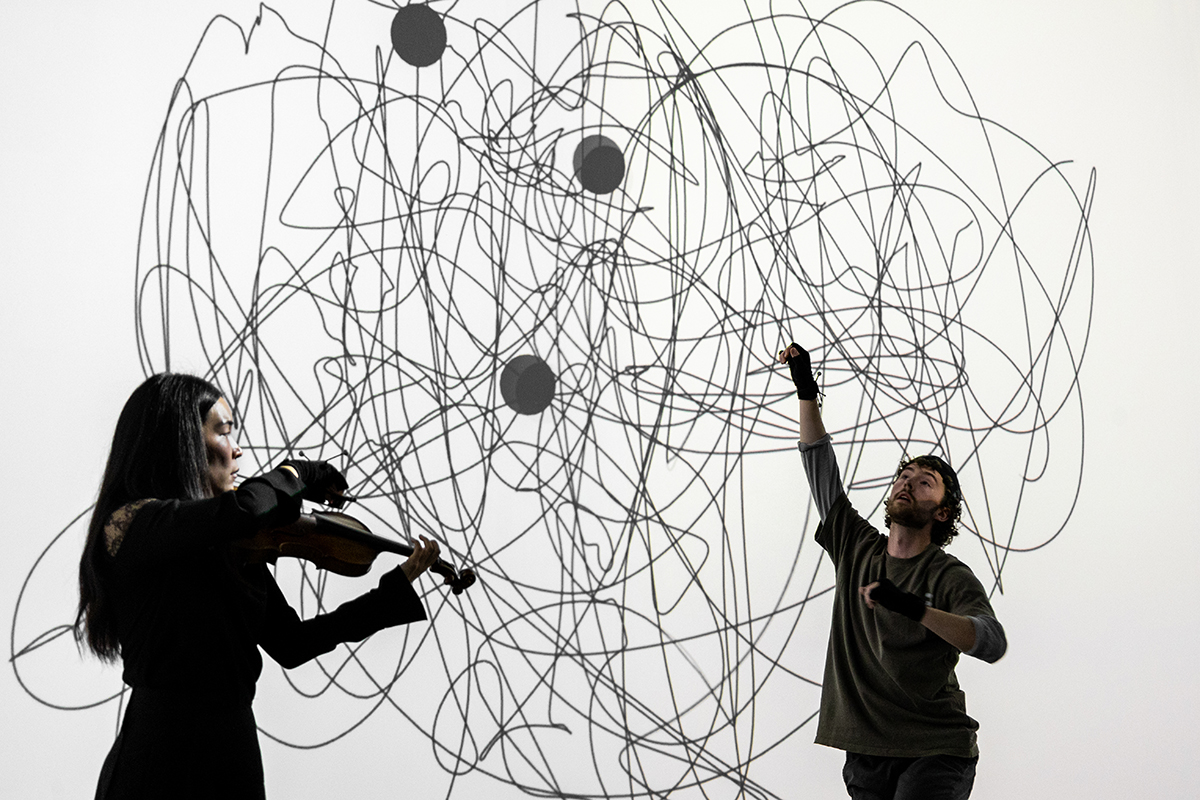
Sounding Bodies (illustrated). This is about immersive and responsive environments in which the audience (particularly young people) can be surrounded by classical music and participate. “By making young musicians the authors rather than the recipients of the experience, we want to explore how future live classical performance can become more inviting, interactive and open to new audiences” says Ali Mohammed, the lead in the project.
Textile Ecologies in which incredibly complex historical textile structures found in archives can be translated into datasets to be used in making modern textiles. “Textile archives hold an extraordinary amount of knowledge about how materials have been constructed, patterned and engineered over centuries” says the project lead Bine Roth. “Through this project, we want to unlock that knowledge digitally and explore how historical weave structures can inform new interactive and responsive textiles”.
Shared Authorship, a UK-Ireland researcher network that explores participatory cultural production in museums and galleries. “Participating cultural practice depends on how knowledge is valued, who gets to shape questions, and who is recognised as an author of change” explains Zey Suka-Bill - and some of this stuff does need explanation, project artist-scientists have an incorrigible love for gobbledygook, but bear with it. “By bringing early career researchers across the UK and Ireland into sustained dialogue Shared Authorship creates space to develop new approaches collectively”.
Digital Heritage is where it gets seriously serious with phrases like “immersive digital heritage experiences”, “Airships XR” and “pedagogy” dotted about the manifest. Basically, it uses virtual, augmented, and mixed reality technology to inspire curiosity about, well, engineering among youngsters. "Our early findings from Airships XR suggest that immersive learning can do more than make engineering engaging” says Atif Mohammed Ghani, a research tutor; “it can deepen understanding and help learners connect technical concepts to the wider social, historical and cultural contexts in which engineering operates”.
The Circular Design Toolbox is another textiles programme. This one translates research-backed experience and design tools into a commercial service. Basically, says the RCA’s Sharon Baurley, it’s a programme that allows cutting edge into textiles can be “circulated” to make it commercially applicable, “to bridge academic innovation with actionable, scalable tools for industry to transition to a circular economy” she says.
Where AI stand in any of this, if it all, I’ve no idea, but using the skills of art making to inform the creation of technology, and the means to use and understand it, is what the RCA was set up to do nearly 200 years ago and is still doing now, better than anywhere else. And nobody died.
.